

The great promise of register modernisation sounds unspectacular: the state should no longer ask citizens for information that it already has. A birth certificate, an extract from the commercial register, a certificate of residence, proof of income or place of residence – information already held in a register should not have to be searched for, copied, uploaded or resubmitted every time. This is a plausible promise and a long-overdue step towards a more efficient administration.
With the National Once-Only Technical System – NOOTS for short – Germany is beginning to deliver on this promise from a technical perspective. Registers, online services and specialist procedures are to be linked in such a way that evidence can be accessed digitally between public authorities. For citizens, businesses and the public administration, this represents genuine progress: less effort, fewer media breaks, faster procedures and better decisions.
It is crucial not to underestimate the significance of this progress. Digitalisation does not merely modernise public administration and businesses by putting forms online or automating individual processes. Its greater impact lies in making information usable across previously existing boundaries: between departments, registers, authorities, areas of responsibility and procedures. Some of these boundaries are legacy technical issues. Some reflect organisational power dynamics. And some are deliberately established safeguards, for example where responsibilities, purposes and powers are intended to remain separate.
Software makes it technically possible to bridge these boundaries. This is precisely where its strength lies – and this is exactly why it is not enough to view integration merely as an efficiency project. It is also a task of design: which boundaries should be removed, which should be bridged in a controlled manner, and which must remain in place?
Generally speaking, digitalisation is usually framed as a story of efficiency: fewer media breaks, faster processes and, with artificial intelligence, the automated analysis of large data sets. This narrative is not wrong. It obscures what is actually happening from a technical perspective. Digitisation separates information from its original medium and makes it possible to copy, link and recombine it at will. For the first time, AI makes this integrability practically usable on a large scale, even for tasks that cannot be fully captured by rules.
This ability to integrate data is by no means a neutral tool. It creates a shift in power on two levels: the very same characteristic that makes the state more powerful internally – by bringing together data sets whose separation previously limited it – makes it more dependent externally, as it ties it to global providers over which it has no control. Internally, there is a risk of too much control being concentrated in one place; externally, there is a risk of too little control over its own capacity to act. It is the same trade-off, but with the signs reversed.
What the Federal Constitutional Court articulated in its 1983 census ruling regarding the linking of individual data records – that data which is harmless in itself becomes dangerous when linked – is now arising anew at the level of entire, AI-supported data spaces, and in a far more acute form. The gain in utility that is supposed to justify this linking depends on one’s perspective. The shift in power is occurring structurally and reliably.
The crucial point does not lie in the digitisation of individual forms or procedures. It lies in the emergence of integrated data spaces. It is only there that it becomes clear why efficiency, power and sovereignty belong together in digital administration.
Data spaces: one characteristic stands out
A doctor’s surgery and a tax office are vastly different institutions. Digitally, however, both have the same representation: data, processed by software. This shared representation gives rise to a series of characteristics that distinguish the digital from the analogue: Information becomes combinable and integrable; it becomes modifiable, lossless and reproducible at will; it is accessible from anywhere and simultaneously by many; it is persistent, meaning that deletion must be a deliberate act; it is invisible, because access occurs only via interfaces; and, finally, it is skalable at will.
Not every digital property is equally important in every context. In the case of deepfakes, it is modifiability and scalability; for social networks, reproducibility and scalability; and for data protection, combinability. This does not mean that the other properties are unimportant for administration: persistence and accessibility are also fundamental. For administration, however, one property stands out in particular: integrability. For administration is, at its core, the binding processing of information across organisational boundaries. It is precisely these boundaries that integrability addresses, and none of the other properties does so in the same way. The others alter what happens to individual data points; integrability alters which boundaries between them still apply.
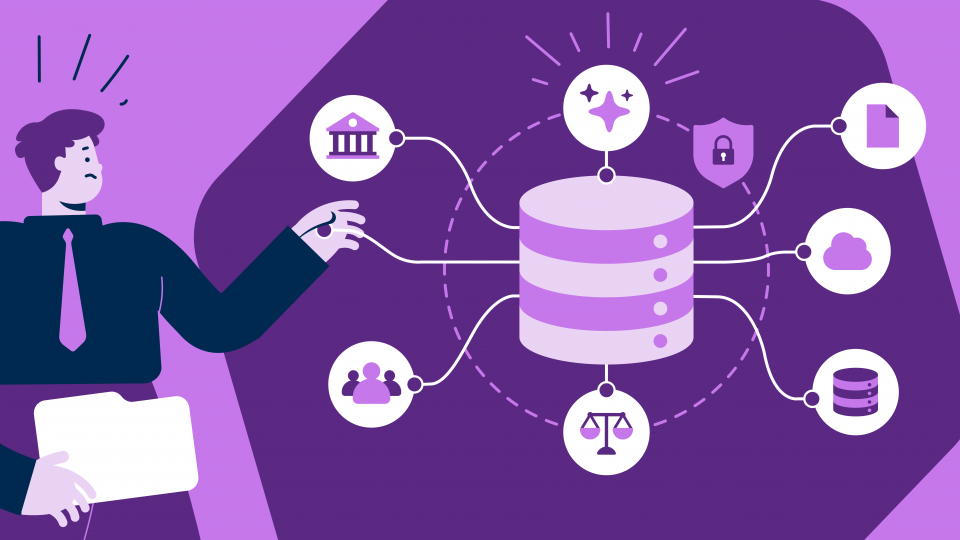
Integratability, together with scalability and accessibility, creates something qualitatively new: no longer just individual linkable data points, but a data space. It accommodates any amount of data, with no physical capacity limits; it spans organisations, transcending the boundaries of authorities, departments and systems, and can be used independently of location and time. The next stage of digitalisation therefore lies not primarily in the automation of individual processes, but first and foremost in the emergence of ever larger and more tightly integrated data spaces.
‘Integration’ comprises four interrelated levels: the linking of data – such as registration, tax and social security data – including at a semantic level; the interconnection of systems via interfaces; the consolidation of processes into a single procedure rather than many individual steps; and, finally, the dissolution of institutional responsibilities. The lower levels initially appear to be purely technical. The higher the level of integration, the more it affects precisely those organisational efforts that are essential for successful digitalisation – and those divisions that are intended under the rule of law. Integration at the level of responsibilities is often not a technical problem, but a political one.
Whether this potential actually translates into benefits, efficiency, new power or new dependencies, however, is only determined afterwards. The size and integration of a data space alone do not yet reveal anything about this.
Benefits: Why greater integration does not automatically yield greater benefits
The fact that larger, more integrated data spaces do not automatically lead to greater benefits or lower costs reflects a long-standing observation. As early as 1987, the economist Robert Solow noted that the computer age could be seen everywhere, except in productivity statistics. The productivity paradox observed by him and later by the economist Erik Brynjolfsson can be seen once again today in the context of digitalisation and AI: massive investment, but not always a measurable effect. A number of reasons for this are known, which essentially show that the efficiency gains from digitalisation depend on perspective and can be contradictory.
Often, the benefits are simply measured incorrectly. Gross Domestic Product (GDP) measures value added – that is, market transactions – not benefits. If digitalisation eliminates intermediaries, GDP may even fall, even though the total benefit is increasing. For example, a booking at a travel agency used to cost 1,000 euros (900 euros for the airline, 100 euros for the agency); today, the same flight booked via a platform costs 930 euros (920 euros for the airline, 10 euros for the platform). The measured GDP falls from 1,000 to 930 euros, even though the customer is flying more cheaply. More subtle is the shift in the nature of the work itself: In the past, a travel agency employee would spend thirty minutes on the task, whilst the customer spent two; today, the platform takes one minute, whilst the customer spends twenty. Paid work becomes unpaid personal effort: using ELSTER instead of a clerk, correctly uploading documents instead of having them checked at the counter. The work does not disappear; it is simply shifted. The overall impact of digitalisation therefore depends largely on the perspective from which it is measured.
In such cases, some of the gains are often eroded. The Jevons Paradox of 1865 describes how more efficient steam engines reduced coal consumption per unit of work, but the freed-up capacity was channelled into ever more applications. Overall consumption rose. If processes become simpler and cheaper to carry out digitally, more or different processes may well be initiated. Integration also generates new coordination efforts of its own, relating to data quality, interfaces, compliance and security. Part of the efficiency gain is thus consumed again.
Without organisational change, the effect fizzles out. In the 1990s, it was demonstrated that IT is only effective in conjunction with organisational change: replacing a typewriter with a PC yields hardly any productivity gains. It is only the reorganisation of entire processes that yields significant results. This point is also the only one of the four that organisations can actively shape themselves. Here, then, lies not only a limitation but also a lever for change.
After all, the actual bottlenecks often cannot be formalised through rules at all. So far, digitalisation has primarily optimised those aspects that lend themselves well to being codified in rules. However, the real bottlenecks in public administration are precisely those tasks that do not lend themselves to this: the professional assessment of individual cases, coordination between departments and levels, the responsibility for a decision that someone must bear, and the exceptional cases that do not fit the rule. These bottlenecks persist because they cannot be formalised – not because digitalisation fails, but because it is ineffective precisely in this area. This is exactly where artificial intelligence will come into play later on.
These reasons also demonstrate that the ‘impact’ of digitalisation projects is not a one-dimensional concept. Usefulness asks what actually benefits the end-user, regardless of whether it is paid for or recorded in statistics. Productivity asks about the output per hour worked and whose hours are actually counted. Furthermore, effectiveness does not ask about the ‘how much’, but rather whether the right problem is being solved at all. Legitimacy, finally, asks about the process: does the procedure itself generate trust and transparency? A process can be productive and yet ineffective – that is, it can efficiently do the wrong thing; or useful yet illegitimate – achieving a good result through unacceptable means. This distinction becomes a practical challenge when objectives and the resulting key performance indicators must be defined prior to a digitalisation project, a task that becomes all the more complex the greater the conflict between these dimensions.
It must be noted that the effectiveness and efficiency of digitalisation projects are complex, perspective-dependent and contradictory factors. We find that it is not always clear in advance, for every digitalisation project, which objectives are to be optimised and in what combination. Disappointment then becomes a consequence of unclear expectations. Many administrative processes are vague, based on estimates and dependent on judgement. Rule-based software can do little to unlock potential in such areas. These are precisely the bottlenecks that remain unresolved because they cannot be standardised. The efficiency gains from digitalisation are therefore anything but trivial or guaranteed.
AI: The tool for vague bottlenecks
A large, integrated data repository that can only be searched using rules remains underutilised for precisely those complex and ambiguous bottlenecks: verification, coordination and exceptional cases. The data repository may be large and integrated, but it is only as useful as the tool used to access it.
What distinguishes AI from traditional software is the concept of correctness. With traditional software, correctness is, at least in principle, binary: right or wrong, defined by an unambiguous specification. The problem is clear enough to be expressed in rules. With AI, on the other hand, correctness is continuous and approximate, precisely because the underlying problem cannot usually be clearly defined. Here, the question shifts from ‘right or wrong’ to something like ‘adequate in 85 per cent of cases’. The question becomes even more difficult when considering to what extent it is possible to determine in advance what ‘sufficiently good’ actually means. (Incidentally, even today, AI is still unable to solve many problems to a sufficiently high standard.) In any case, however, it is precisely this ability to tackle vaguely defined problems that makes AI the tool which, for the first time, renders the massive, heterogeneous integration of information operationally usable on a large scale: no longer merely technically connectable, but analysable. Previously, organisations were mainly able to link data that already looked the same: numbers, fields, tables. AI can now also bring together files, notes, expert reports, free-text and case descriptions according to their meaning. This means that not only is more being processed, but it is being processed differently: the boundary is shifting from technical linkage to semantic indexing, which often remained inaccessible to the rule-based world.
AI and integration reinforce each other in this process. In one direction, AI benefits from integration: the larger and more diverse a clean and partially labelled data set is, the more context there is, the better the patterns, and the higher the hit rate. Conversely, AI enables new forms of integration. It can link content across different data sets that are similar not only in terms of overlapping table columns, but also in terms of their meaning – a form of semantic integration that extends beyond data, systems, processes and areas of responsibility. The result is a virtuous circle: more integrated data improves AI, and better AI enables greater integration. Integratability is therefore not merely a characteristic of the digital realm – it is reinforced by AI itself.
However, one key reservation remains: many procedural obstacles within the public sector, just as in the private sector, are not of a technical nature but relate to power politics. Even the best tool cannot change this. This does not weaken the argument, but rather supports it. Where AI fails due to the political nature of the bottleneck, the efficiency gains are not realised; however, the integration of data sets – and thus the impact on power dynamics – has long since been achieved.
A further consideration concerns the widespread assumption that the value of any process lies solely in its outcome. This is not always true, and this is where the aforementioned legitimacy comes into play once more. Some processes are epistemic in nature: they generate understanding, judgement, organisational memory, professional competence and legitimacy – in other words, the traceability of the path leading to a decision. Heinrich von Kleist’s image of the ‘gradual formation of thoughts whilst speaking’ can be applied here: The process of speaking is the necessary vehicle for developing one’s own intention in the first place. If the focus is solely on the artefact, the function of creating meaning and legitimacy associated with its creation may be lost. The relevant question is therefore not merely whether AI can produce a result, but whether it preserves or strengthens this function. Consequently, legitimacy itself becomes a point of contention in the power struggle, rather than merely a side-effect of process design.
The very same characteristic that makes AI suitable for ill-defined tasks within large, integrated, heterogeneous data spaces is identical to the characteristic that undermines institutional divisions. And AI requires the same organisational transformation as traditional IT did before; otherwise, the typewriter problem will simply be repeated with language models.
Power and sovereignty: the same trade-off on two levels
Public administrations collect, verify, link and utilise information to prepare, make and implement decisions that are binding on society. From a purely efficiency-based perspective, separate areas of responsibility and data sets appear to be friction that has built up over time. This is a problem that integration can solve. However, many of these divisions are not historical coincidences. Some are simply due to power interests and are implicit. Where the control of power is to be institutionalised beyond this, principles such as the dual-control principle and co-determination apply. These mechanisms are also found in companies, irrespective of any state objectives. Another part is specific to the state: deliberately established or legally required limitations on state power, such as federalism, the separation of powers, data protection as a fundamental right, or judicial review, to ensure that information and decision-making power do not converge in a single place. From an efficiency perspective, both groups are equally obstructive, but they exist for different reasons: the former to safeguard intra- and inter-organisational power relations, the latter to limit the power of the state: protection lies in separation. This is not new, but is enshrined in constitutional law. In 1983, the Federal Constitutional Court, in rejecting the Census Act previously passed unanimously by the Bundestag, justified the right to informational self-determination precisely on the grounds that data which is harmless in itself becomes dangerous when linked; the principle of separation between intelligence services and the police codifies the same idea. Here, separation is not an obstacle to efficiency, but the protective mechanism itself. It is precisely this that is at stake when integration erodes it.
This leads to the core paradox for the state apparatus: the very same integration that eliminates information gaps, media discontinuities and friction must, and can, at the same time, dismantle institutional separations that originally served to limit state power. AI exacerbates this, because semantic linking itself allows the processing of datasets without taking their individual roles into account. The case of data integration with a provider such as Palantir illustrates this perfectly. The real question here is neither how the political views of the company’s founder, Peter Thiel, should be assessed, nor simply how data protection can be organised in relation to a US company, as the public debate often suggests. The real question is political: to what extent should checks and balances – or, more precisely, the deliberate restriction of central executive control through separation and decentralisation – be sacrificed for the sake of efficiency? There is no black-and-white answer to this: gradual measures such as purpose limitation, access logs or auditability can preserve some degree of control without forfeiting the full efficiency gains. But they merely shift the trade-off; they do not eliminate it: efficiency gains and shifts in power are inseparable. Anyone who wants integration must expect a shift in power and shape it politically, rather than treating it as a technical side-effect.
At a higher level, the same pattern repeats itself in reverse – the second aspect mentioned at the outset: digital sovereignty. Anyone wishing to reap the benefits of integration ties themselves to global ecosystems: the cloud, models, infrastructure. Structurally, this is the same trade-off as the core paradox, only one level higher. Integration goes hand in hand with interdependence: in data formats, interfaces, identity, workflows, operations and staff expertise. Interdependence creates lock-in, because whilst a single tool is, at least sometimes, replaceable, an integrated ecosystem comprising storage, identity management, office software, collaboration, AI and security is hardly replaceable – unless one opts for the European approach of a complete ‘Euro-stack’, which, in the light of this discussion, does not appear convincing in every respect. And lock-in becomes a political issue as soon as the function in question is critical: in the case of administrative communication, identity, police, healthcare or AI infrastructure, technical dependency turns into political vulnerability.
American or Chinese technology enables efficient, innovative processes through the same integration advantage as seen domestically, only this time between the state and global providers. Unlike domestically, however, control here is not concentrated in the hands of the state – it shifts away from it. This is a reversal of the situation: domestically, there is a risk of too much control in one place; externally, there is too little control over one’s own capacity to act. In both cases, separation also serves as a safeguard against concentrated control, which integration exchanges for efficiency. Digital sovereignty is therefore not synonymous with self-sufficiency. Complete independence would usually mean losing precisely those integration benefits that make digitalisation attractive in the first place. Sovereignty rather means the ability to exercise control: can the provider be changed, can data be migrated, can emergency operations be maintained in the event of a crisis, can systems be audited, and is it possible to prevent an external actor from effectively gaining a right of veto?
Politicians can shape the external trade-off between the state and providers without eliminating it: through supply chain resilience and redundancy rather than single points of failure, by maintaining, for example, emergency capacity for exceptional circumstances as well as redundant critical data and systems, through technological leapfrogging rather than imitation in the sense of Walter Ulbricht’s phrase – now often quoted ironically – of ‘overtaking without catching up’, that is, by taking the next step rather than trailing behind the status quo; and through an understanding of dependency as mutual leverage – that is, as a bargaining chip and not merely as a risk. These strategies mitigate the external trade-off because redundancy is fundamentally possible there: a second provider can replace the first.
However, for a structural reason, they do not resolve the internal trade-off between integration and checks and balances – or, in other words, between deliberate domestic decentralisation and restrictions on control to prevent the executive from abusing its power. In this context, the separation itself is the safeguard that no redundancy can replace. What remains, therefore, is not a technical but a procedural response, one that does not pre-empt the actual value judgement but rather makes it visible. Three principles can be outlined: Firstly, integration at the level of competence should never be a by-product of a purely technical decision, but should require a domestic negotiation of power relations as well as a proper impact assessment of the distribution of power. Secondly, it is separation, not integration, that should be the exception requiring justification, and not the other way round. Thirdly, architectures should remain reversible and auditable, so that decisions remain open to revision and do not become effectively irreversible due to lock-in. This does not resolve the conflict. It ensures that it is resolved openly, rather than arising unnoticed.
Conclusion
There is no technical solution to the trade-off between integration, power and sovereignty. No technology can guarantee efficiency without the risk of a shift in power. The extent of the efficiency gain depends on one’s perspective; the shift in power occurs structurally. Politics can shape the external trade-off through redundancy. The internal trade-off, which is directed against checks and balances, cannot be safeguarded through redundancy and ultimately remains a value judgement which, whilst it can be made transparently, may be associated with the risk of irreversibility. Every decision on integration simultaneously distributes informational power.
The entire argument can be summarised as follows: digitalisation increases the integrability of data; data integration generates informational power; and informational power creates the trade-off between efficiency and the limitation or distribution of power. The benefits of digitalisation and AI represent the performance aspect of this development; data protection, state power domestically and in relation to citizens, and sovereignty in international relations represent its power aspect. The two are therefore not separate; they stem from the same root.
Digitalisation is at least as much an organisational matter as it is a technical one. The success of digitalisation measures depends on which targets are to be optimised, how conflicts of interest are resolved, and whether there is clarity on these issues before the measures are implemented. The central issue of shifting power relations must be a key component in the definition and implementation of digitalisation strategies, on both a small and a large scale.
A shorter version of this article was published on October 15, 2026, in Tagesspiegel Background Digitalisierung & KI.
Read the German article in Tagesspiegel Background
The blog posts published by the bidt reflect the views of the authors; they do not reflect the position of the institute as a whole.


