

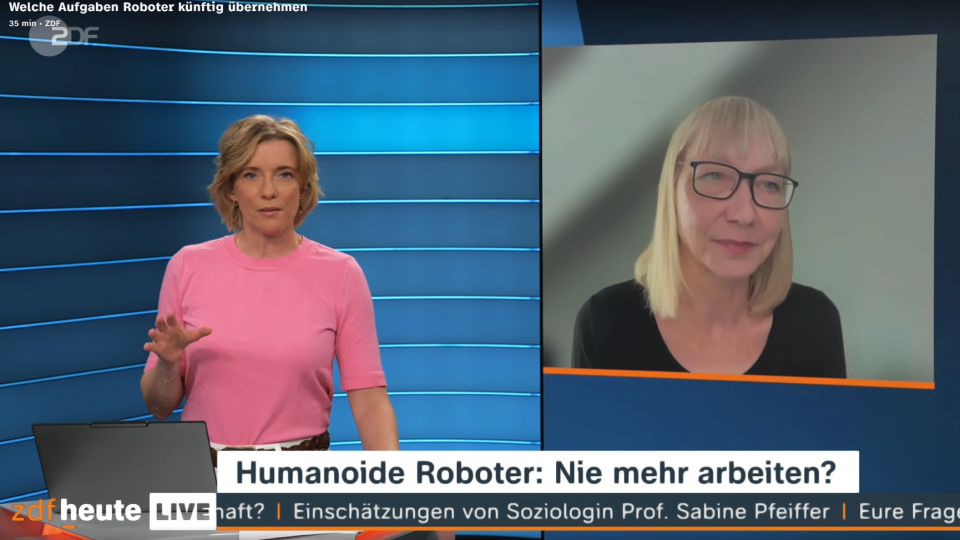
Will humanoid robots take over our jobs in the future? On ZDFheute live, Professor Sabine Pfeiffer, a sociologist of work and Chair of the bidt Board of Directors, explains the technical, economic and social issues involved. Other media reports pick up on her views regarding changes in the world of work.
Humanoid robots: from demonstration to everyday life
At the Robot World Cup in Beijing, the humanoid competitors demonstrated just how rapidly the technology is advancing. The machines competed in sporting disciplines, impressively transported objects and displayed skills that could well be in demand in the future – whether in industry, the service sector or the home. In the 27 August 2026 edition of ZDFheute live, presenter Christina von Ungern-Sternberg discussed with robotics expert Professor Jan Peters (Technical University of Darmstadt) and sociologist of work Professor Sabine Pfeiffer (FAU Erlangen-Nuremberg and Chair of the bidt Board of Directors) about what humanoid robots are actually capable of – and what consequences their use would have for work and society.
For Pfeiffer, the spectacular images tell only half the story. What works under controlled conditions must first prove itself in the complexities of everyday life:
I am a bit more sceptical about that. Robotics is currently making enormous strides in innovation. However, turning what is technically possible into reality in everyday life – for example, in a factory or a care home – is another huge step altogether. This is evident at every stage of automation.
 Prof. Dr. Sabine Pfeiffer To the profile
The example of care work illustrates exactly what is meant by this. In this context, robots would have to interact, under time pressure, with people whose physical and mental condition can change from one day to the next. Even putting on a compression stocking requires situational awareness, care and experience. The technology is still a long way from being able to deploy humanoid robots reliably in such situations.
Added to this are very practical requirements: robots need maintenance, updates, safety protocols and qualified staff. Their deployment must also be economically viable. Nor is the humanoid form the best solution for every task. In highly automated factories, specialised systems may be superior to a robot balancing on two legs. In private households, on the other hand, additional questions arise regarding data protection and cyber security, because a helpful robot would need to know a great deal about its surroundings and the routines of the people living there.
Automating individual tasks, replacing entire professions?
This is another reason why Pfeiffer considers the idea that robots could replace entire professions in the foreseeable future to be short-sighted. Initially, it is individual, clearly definable tasks that will be automated. Professions, however, encompass far more: experience, communication, judgement and the ability to deal with unexpected situations. Furthermore, viewing people merely as a cost factor fails to recognise their role in creating value within companies.
It thus shifts from a technical issue to a social one. Pfeiffer responds soberly to the vision that, in future, work could become ‘optional’ thanks to robots and artificial intelligence: it is not technology alone that determines which jobs will remain, how the benefits of automation will be distributed, and how people will earn a living. Rather, these matters must be negotiated at a societal level.
The automotive industry needs a strategy for the future
Pfeiffer’s assessment on the ZDF programme WISO also highlights just how important it is for new technologies to be properly embedded within a socio-corporate context. In the interview, recorded at the bidt, she discusses the crisis facing the German automotive industry. Previous avenues for growth – such as the Chinese market and attractive leasing models – have largely been exhausted. Announced factory closures may well be part of company-level negotiations. However, Pfeiffer sees the more fundamental problem as lying in the lack of a clear vision of which products and business models the industry intends to use to ensure its future success. Staff cuts alone are no substitute for a future strategy.
AI in the workplace: relief is not a given
The fact that a technical aid does not yet constitute a complete replacement – nor an automatic promise of reduced workload – is a recurring theme in recent media appearances. In the t3n podcast, Pfeiffer explains why artificial intelligence can actually increase stress in the workplace: If expected productivity gains are hastily translated into tighter time and staff budgets, whilst at the same time additional monitoring work arises, the workload is more likely to increase than decrease. It is therefore crucial to consider the specific use case, potential errors and necessary checks right from the start.
Even when used as a stand-in during holidays, artificial intelligence can take on clearly defined routines, but cannot automatically fulfil the entire role of a colleague, as Pfeiffer explains in an article in WirtschaftsWoche. In an interview with the Fränkischer Tag, Pfeiffer finally broadens the perspective to include the current debate on working hours and economic performance: simply working more is not a sufficient response to the present challenges.
The four-part ARTE documentary „Hauptsache Arbeit“ also explores how work is changing under the influence of new technologies. With regard to artificial intelligence, it serves as a reminder that technical systems are not error-free. We still need people to assess their results and verify their accuracy.
Across all the articles, Pfeiffer paints a clear picture: technology alone does not determine the future of work. What matters is the tasks for which it is used, how businesses organise its deployment, and how the benefits, risks and profits are distributed across society. The key question is therefore not whether a robot can sprint (faster than a human), but rather whether technology reliably supports people in their day-to-day work.
Access the articles
ZDF heute Live (In German)
ZDF WISO – Das Wirtschaftsmagazin (In German)
t3n (In German)
Arte-Dokumentation (In German)
Fränkischer tag (Paid Content, In german)
WirtschaftsWoche (Paid Content, In German)


