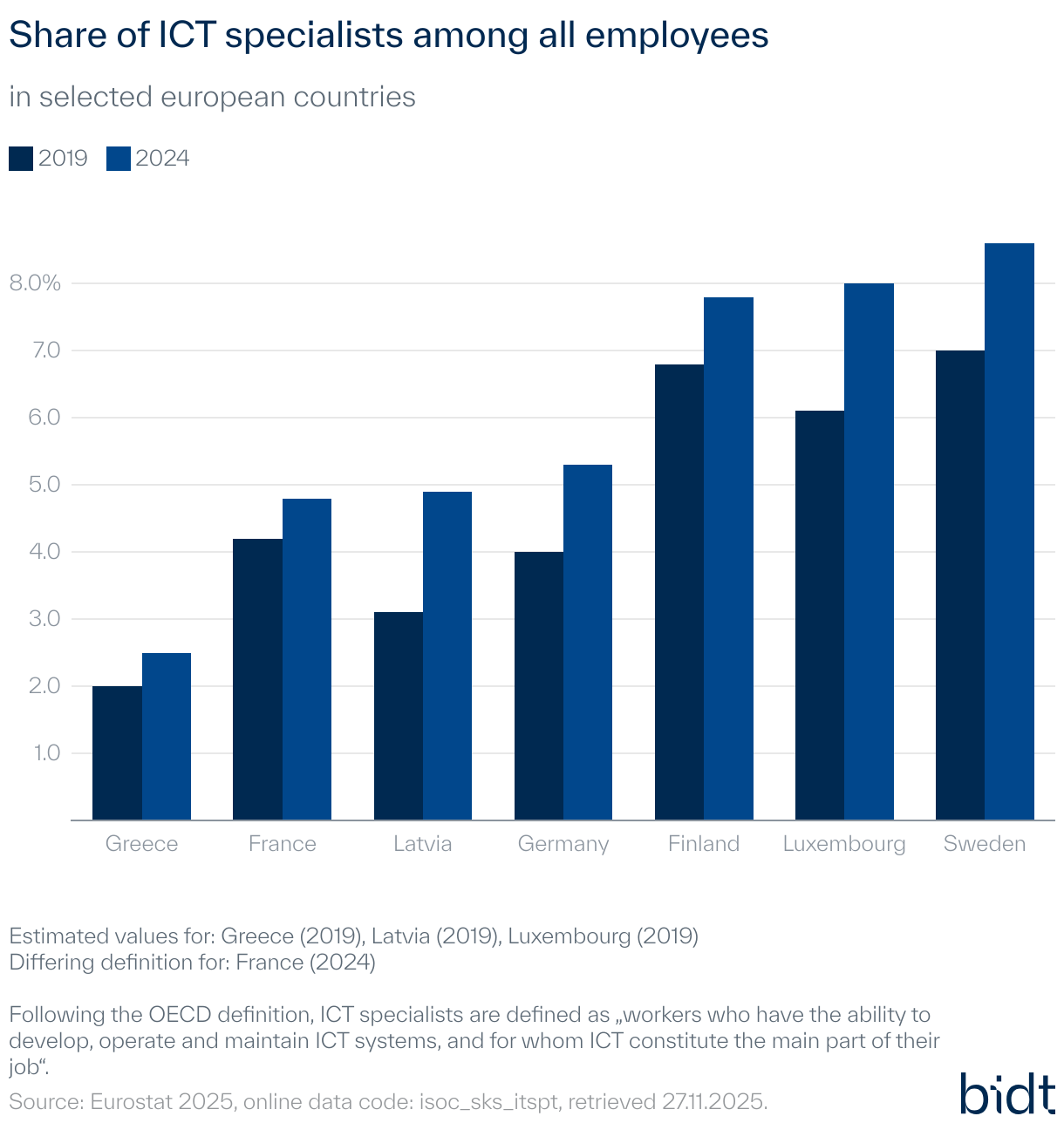
In 2024, the share of ICT specialists among all employees was particularly high in Estonia, Latvia and Malta, at around 8% each. Greece, on the other hand, had a low proportion of ICT specialists in its workforce. Germany ranks in the middle, having seen an increase in the proportion of people employed as ICT specialist from 2019 to 2024, as in almost all other European countries, .
Employed ICT specialists
The indicator shows the proportion of ICT specialists among all employees in a country. It thus provides insights into how well the national economy is positioned for digital innovation, competitiveness and transformation. At the same time, it illustrates how effectively companies are able to use digital technologies.
Network Readiness Index
The Network Readiness Index (NRI) is a composite index that measures a country’s digital readiness. It examines how effectively digital technologies are used across the four dimensions Technology, People, Governance and Impact.
AI competence
The indicator is based on a self-assessment test developed by the bidt think tank and, in line with DigCompSAT, measures which competencies for dealing with artificial intelligence respondents possess. It thus helps to illustrate…
bidt-Digitalbarometer: Digital competence
The indicator, based on self-assessment, illustrates how digital competence is distributed among the German resident population aged 14 and above. The indicator provides insight into which population groups in Germany are better…
Knowledge about AI
The indicator provides information on how the German resident population aged 14 and over assesses their knowledge of artificial intelligence.
Demand for ICT professionals
The demand for ICT professionals indicator shows how large the share of companies is that have attempted or actually hired ICT professionals.
Working from home usage
The indicator home office use shows the proportion of people who work from home in European countries or in Germany. In this way, the indicator shows changes in the world of work.