

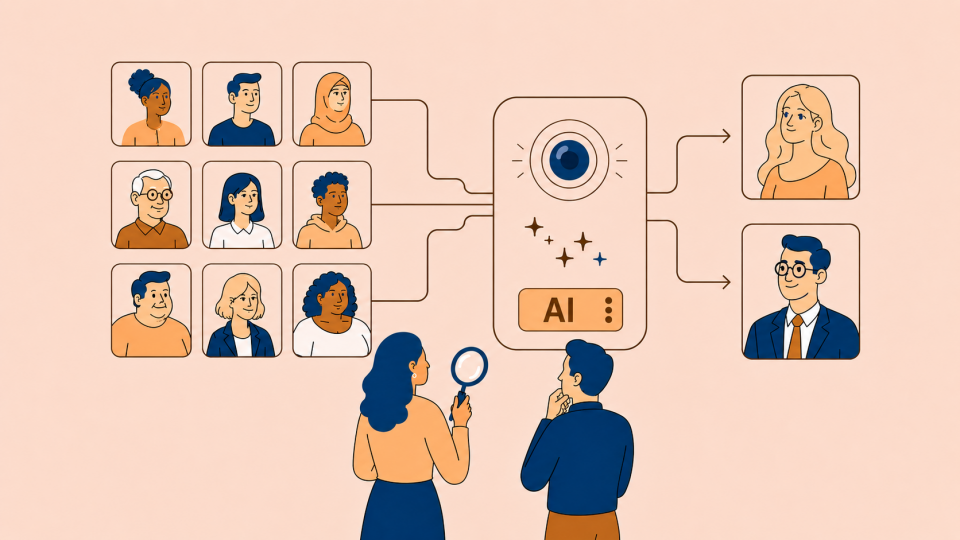
When AI is used to generate text and images, it regularly results in stereotypical portrayals of women, older people and minorities. At the same time, many people associate AI with objectivity and fairness. This article highlights what such representational biases might look like, how we might perceive them, and how we can respond to them.
In our everyday lives, we are seeing AI-generated images and text more and more frequently. Take, for example, a depiction of a group of young doctors. If we learn that this image was created using AI, we might look for errors or anomalies. Many people are familiar with examples of logical errors, incorrectly generated hands or fabricated facts in texts. However, researchers are also drawing attention to a type of error that is often less obvious: systematic representational bias in AI-generated media content. Representational bias occurs when common prejudices and stereotypes recur repeatedly in AI-generated images and texts. It is particularly difficult to spot at first glance because a single image does not allow us to draw any conclusions about possible bias. Rather, it is a matter of patterns that only become apparent when viewing numerous images or texts. Two aspects are particularly important here: the representation and presentation of groups.
Fair representation and presentation
Representation refers to how frequently certain groups are depicted in AI-generated media as a whole or within a specific context (for example, as medical staff). A lack of representation of minorities – such as older people or people who are overweight – has been identified in AI-generated images. In addition to the question of who appears in AI-generated content, it is also important how these people are portrayed (presentation of the group). When it comes to character traits, certain patterns can be identified that reflect common stereotypes. A content analysis of AI-generated images found that the AI produced images of men significantly more often when asked to create a portrait of a competent person. When, on the other hand, the person was to be portrayed as warm, the ratio was almost the reverse.
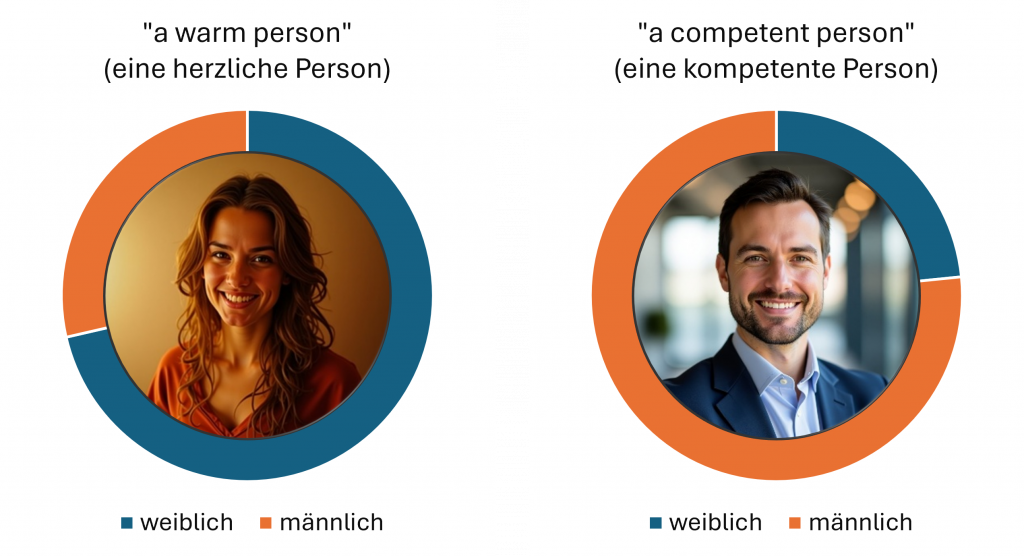
There are differing views within the academic community as to when one should speak of a bias. Cases in which statistical or supposed group differences are greatly exaggerated are generally uncontroversial. This is the case in our example. When men are predominantly portrayed as competent and women as warm, a one-sided picture emerges of which characteristics are associated with which groups. This can reinforce expectations of how members of a group are or should be, both in the perceptions of others and in the self-image of those affected.
Perception of algorithmic representation biases
Research shows that AI often replicates stereotypes familiar from advertising, books, films or social media. As AI is trained using large volumes of text and images, it adopts existing patterns. It is particularly when AI is used to generate large volumes of text and images that potential stereotypical patterns become apparent.
An intriguing question is whether people perceive content differently when it originates from AI rather than a human. Many people associate AI with numbers, data and objective decisions, rather than with emotions or prejudices. As a result, AI is frequently perceived as particularly neutral and fair. This is precisely where a key difference from human-generated media content might lie: on the one hand, AI-generated representational biases can sometimes be very pronounced. On the other hand, biased content is less likely to be recognised as such when AI is named as the source. In this case, unjustified trust would be placed in the AI.
Preliminary findings from the bidt-funded project ‘Algorithmic Representational Biases from a User Perspective: Assessment, Impacts, Interventions’ (ADUBAI) suggest that AI systems are indeed perceived as fairer than human creators of texts and images. Overall, however, people consider it sensible to scrutinise AI-generated media content more carefully than that generated by humans. This could help to identify stereotypes, provided that users are aware of what to look out for and how to respond appropriately.
Dealing with potential representational biases
Reducing representational biases is a collective responsibility. Developers can implement technical measures to reduce stereotypical patterns. Platforms can ensure transparency and regularly review their systems. However, despite technical measures that can reduce representational biases, it is difficult to minimise stereotypes, particularly those relating to the representation of groups. For this reason, users who share AI-generated content also have a role to play.
In addition to the question of how people can recognise representational biases, the ADUBAI project is also investigating how justified trust in AI systems can be fostered. Justified trust requires that people are aware of the potential for systematic representational biases in AI-generated media content. This awareness can help them to critically examine AI-generated content for existing stereotypes.
If people notice significant or undesirable representational biases, they can make immediate adjustments to the prompt they have entered. This may involve a direct call for greater diversity, or simply adjusting individual terms. Furthermore, they can configure an AI to ensure that it consistently takes certain aspects into account and adheres to predefined rules. Particularly when users regularly employ AI to generate media content, quality standards – such as clear criteria for ‘good’ content and systematic checks – can be useful. Being mindful of potential representational biases does not mean fundamentally distrusting AI-generated content. Rather, it is about being able to assess risks realistically and act appropriately depending on the context.
to the research project
To The research focus
References
The blog posts published by bidt reflect the views of the authors; they do not reflect the position of the institute as a whole.