

This bidt survey examines public opinion on a possible ban on social media for children and young people, as well as on a mandatory real-name requirement on social media. In addition to representative findings for the online population in Germany, comparative findings for the online population in Bavaria are also provided.
Key findings at a glance
A major socio-political debate has currently flared up in Germany regarding the use of social media by children and young people and its consequences. Against the backdrop of the ban on social media for children and young people in Australia, discussions are currently taking place in Germany too regarding the introduction of further regulatory measures, including a ban on social media for those under certain age limits. At the same time, questions regarding the practical feasibility and effectiveness of such measures, as well as their impact on participation and media literacy, are the subject of heated debate. Against this backdrop, this study examines the attitudes of the German population towards a possible ban on social media for children and young people, based on a representative survey of the population.
The results are based on a survey conducted by the market research institute Statista Research on behalf of the Bavarian Research Institute for Digital Transformation (bidt). To this end, 2,500 internet users in Germany aged 16 and over were surveyed online between 15 and 29 April 2026. The results are weighted to be representative by age, gender, education and federal state. In addition, as part of the survey, 891 people aged 16 and over living in Bavaria were also surveyed online, meaning that results for Bavaria – weighted to be representative by age and gender – are available for comparison with the figures for Germany as a whole (see also the appendix to the study).
Klicken Sie auf den unteren Button, um den Inhalt von Datawrapper zu laden.
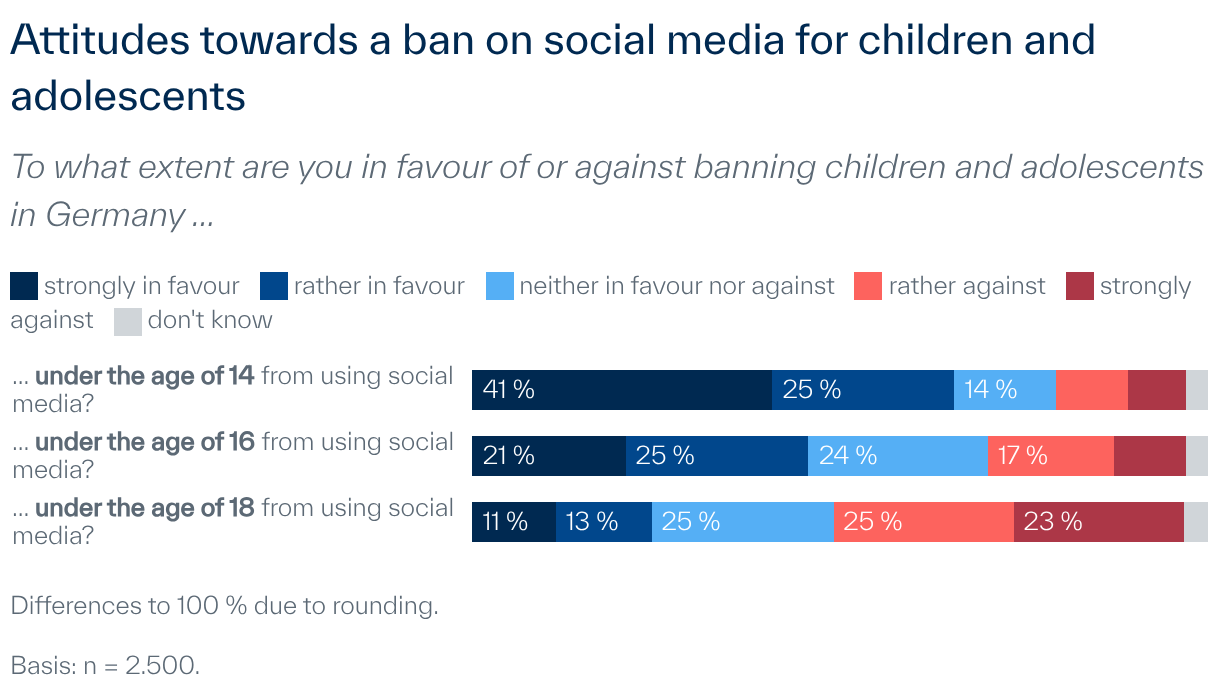
In Germany, a broad majority of the population is in favour of a ban on social media for children and young people under the age of 14. However, support for a ban decreases as the age limit rises. Various socio-demographic characteristics show little correlation with attitudes towards a ban. At the same time, however, a majority also believe that a ban will not be able to prevent children and young people from actually using social media.
Klicken Sie auf den unteren Button, um den Inhalt von Datawrapper zu laden.
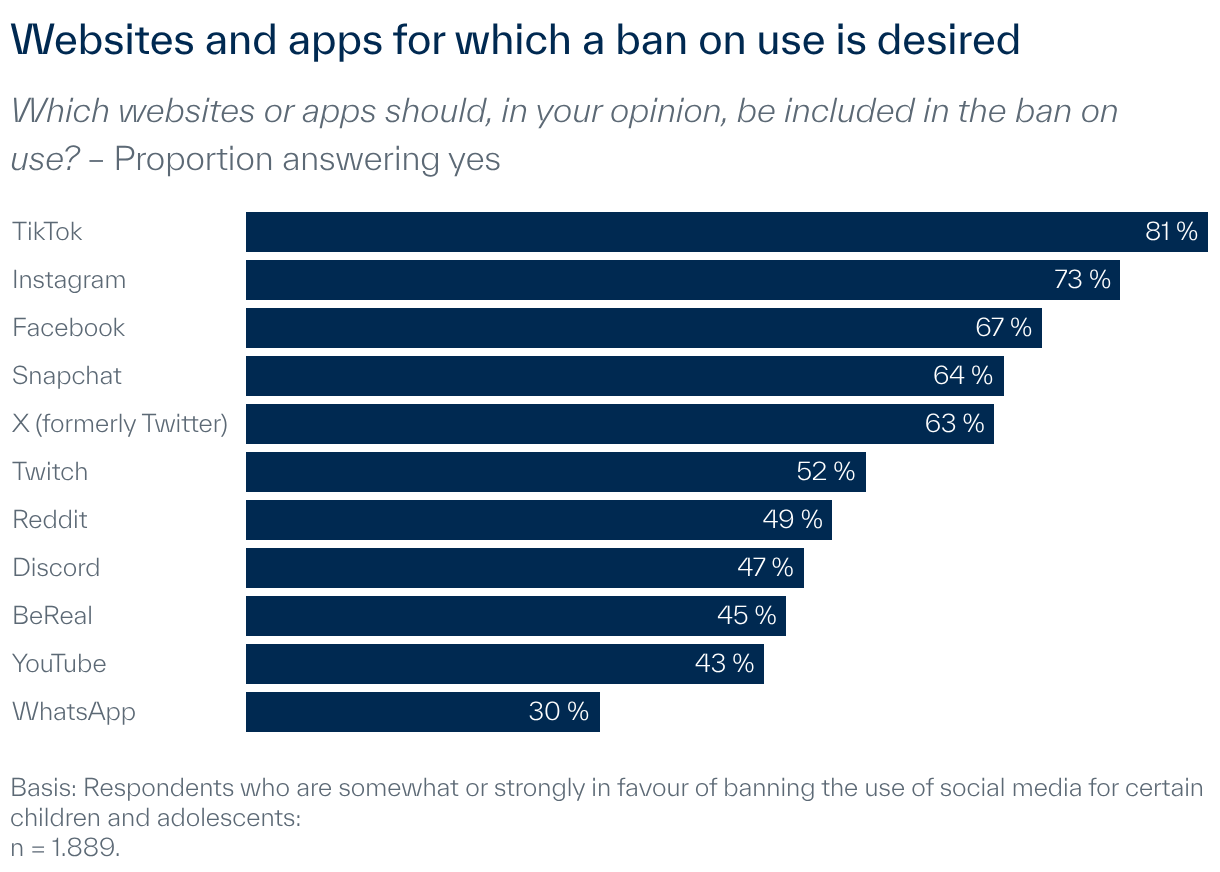
When asked about specific platforms that should be subject to a ban, TikTok, Instagram and Facebook were mentioned most frequently, whilst YouTube and WhatsApp were mentioned least often. It should be noted, however, that the level of familiarity with the respective platform and its functions may influence these assessments.
Klicken Sie auf den unteren Button, um den Inhalt von Datawrapper zu laden.
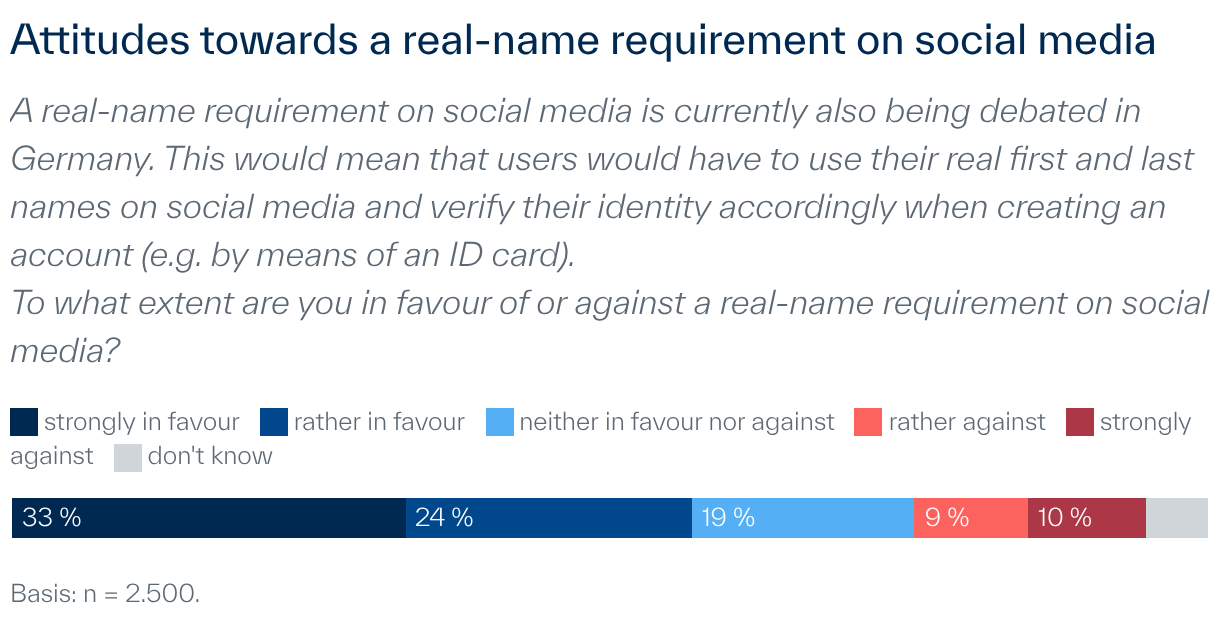
There is also a clear majority in the German population in favour of a mandatory real-name requirement on social media. Support increases with age, and even among parents and people who do not use social media, support for a real-name requirement is slightly higher than among those without children or social media users.
The study provides important insights into public opinion and thus forms a basis for the current socio-political debate on a possible ban on social media for children and young people.
Policy-Brief (IN GERMAN)


