


A pilot project shows how a bidt partner company was able to use a short version of the DigCompSAT from the ‘bidt Digital Barometer’ to easily and efficiently assess the distribution of general digital skills among its workforce in order to derive measures.
As part of a pilot project, a large German company from the mechanical engineering sector with locations worldwide has applied a short version of the DigCompSAT (Digital Competence Self-Assessment Tool) from the “bidt Digital Barometer” to its employees. The project shows that this is a simple, quick and efficient way to record the distribution of general digital skills among all employees across different roles and functions. The results provide the company with an overview of employees’ general level of expertise in dealing with digital technologies. In-depth analyses can provide starting points for deriving specific measures – such as further training activities – or form the basis for further recording specific employee skills by company function.
„By using DigCompSAT, we were not only able to measure how we are positioned globally in terms of individual digital competences, but also to highlight the extent and development of these competences by incorporating company-specific aspects.“
The company's Digital Transformation Manager
Importance of digital skills in working life
The digital transformation is permanently changing the world of work, changing how products are developed, produced and marketed. However, it is also changing how companies are organised and how customers and companies interact with each other. For example, digital technical drawings and simulations have become an integral part of product development. In manufacturing, more and more manual work goes hand in hand with automated processes or is completely replaced by industrial robots. Digitalised business models and digital sales channels are playing an increasingly important role in marketing. In customer service, written and telephone enquiries from analogue times have become less important and emails and chats, now often supported by fully autonomous AI chatbots, have gained in importance. Digital data and diverse software solutions have become indispensable in the administration of companies. The current integration of generative AI into some business processes is further accelerating the digital transformation. This change in practically all areas of the world of work is also continuously changing the skills required of employees. It is estimated that around 90 per cent of jobs require some degree of digital skills (European Parliament 2017). As early as 2018, digital skills were a basic expectation of job applicants in around 80 per cent of the online job advertisements analysed in Germany (Schleiter/Da Silva Zech 2020). In addition, 91 per cent of the working population in Germany currently consider digital skills to be important or very important for their professional life (Stürz et al. 2025). The figures make it clear that basic, general digital skills are now essential for every employee in order to participate in digitalised working life.
However, some employees still do not appear to be sufficiently equipped for the digital transformation. The latest results of the “bidt Digital Barometer” show that 15 per cent of employees in Germany do not even have average general digital skills. In addition, 44% of employees rate further training opportunities on the topic of digitalisation in their own company as fairly or very poor (Schlude et al. 2025; Stürz et al. 2025).
Employees who do not have the necessary general digital skills can quickly become a problem for companies. This is not only because these employees can no longer be integrated into processes in an ever faster changing world of work, but also because they can hinder efficient (digital) collaboration in teams and delay the company’s digital transformation overall. In order to be as well positioned as possible for the advancing digital transformation, companies must therefore ensure that they not only have sufficient skilled workers with specialised digital skills in certain functions. It is equally important that all employees have the best possible general digital skills. Taking stock of the digital skills of employees in the company is an important first step in order to gain an overview of the status quo and to derive starting points for improvement measures from the distribution of digital skills.
Recording digital skills
Digital skills are skills and knowledge that enable people to participate in life in a digital society. They are not limited to purely functional skills in dealing with information and communication technologies (JISC 2014; Stürz et al. 2023). In addition to skills, digital skills also include the knowledge and attitudes required to use information and communication technologies to complete tasks, solve problems, organise information, collaborate with others and create and share digital content. Furthermore, they describe an appropriate, effective, efficient, critical, autonomous, flexible and ethically reflected knowledge development for action in all areas of life (Ferrari 2012).
Identifying and categorising different key digital skills is a major challenge as these skills are often time and context dependent (JISC 2014). Based on numerous other concepts for the systematisation of digital skills (Ferrari 2012), the Joint Research Centre of the European Commission (JRC) developed the European Reference Framework for Digital Competences, DigComp for short (European Commission 2021). The first version of this reference framework was published in 2013 and has been continuously developed since then. Version 3.0 is expected to be published by the end of 2025 (European Commission 2025). In the current version 2.2, DigComp defines 21 individual competences from the competence areas “Handling information and data”, “Communication and collaboration”, “Creating digital content”, “Security” and “Solving problems”, which are considered important for all citizens in the EU for participation in digital private and professional life (Vuorikari et al. 2022). The DigCompSAT (Digital Competence Self-Assessment Tool) self-assessment tool developed by the JRC in 2020 in a multi-stage process enables a simple assessment of digital competences according to the DigComp reference framework by means of an evaluation of 82 individual statements. The individual statements cover the five competence areas and the competence types “knowledge”, “skills” and “attitudes” of DigComp. The competency assessment is based on a self-assessment in which the respondents can answer the individual statements on a four-point scale depending on the type of competency (Clifford et al. 2020). The bidt has translated and adapted the competency test for use in Germany. Furthermore, it has now applied it in two waves of surveys in Germany and in a further wave of surveys in six European comparison countries (Stürz et al. 2025; Stürz et al. 2023; Stürz et al. 2022). The individual statements can be summarised in an index ranging from 0 points (no digital skills) to 100 points (maximum digital skills in the self-assessment test). This allows an immediate impression of the level of general digital skills to be conveyed in a single aggregated figure (Stürz et al. 2023, 76 ff).
As analyses by the JRC (Vuorikari et al. 2025) and the bidt have shown, the index can be statistically mapped relatively well from all 82 individual statements by querying only 21 selected, particularly meaningful individual statements, which form the so-called DigCompSAT-mini (Stürz et al. 2023, 76 ff; Vuorikari et al. 2025). For example, while the full test for employees in Germany provides an average competence score of 65 points (Stürz et al. 2025), the DigCompSAT-mini provides a qualitatively identical result with a score of 66 points.
The survey of 21 individual statements of the short version of the DigCompSAT can also be a simple, efficient way for companies to record the status quo of the distribution of general digital skills among employees. On the one hand, the use of this test offers the advantage of direct comparability with the representative data of employees in Germany from the surveys of the “bidt Digital Barometer” – also with specific sectors (Stürz et al. 2025; Stürz et al. 2022). Secondly, recording digital skills on the basis of the DigComp reference framework allows a direct link to many existing continuing education programmes, as the reference framework is now used in a number of areas in many EU member states. For example, it is also widely used to design, evaluate, improve and, if necessary, certify further education and training activities (Vuorikari et al. 2016).
Distribution of digital competences at the bidt practice partner company
As part of a pilot project, one of bidt’s practice partners, a German company in the mechanical engineering sector with more than 1,000 employees at various locations around the world, used the DigCompSAT-mini as part of a larger-scale evaluation of the company’s digital transformation. The aim of the deployment was to quantitatively record the general digital skills of the employees in order to derive potential for development. As part of the evaluation, the quantitative test was also supplemented by detailed qualitative surveys in individual areas. This allowed the company not only to measure how it is positioned globally in terms of individual digital skills, but also to shed light on the extent and development of these skills by incorporating company-specific aspects.
The DigCompSAT-mini data was collected by means of a quantitative online survey on a voluntary basis and with the anonymised participation of employees from various business units of the practice partner in Europe (07.10.-25.10.2024, n = 175), in China (25.11.-12.12.2024, n = 83) and in India (11.02.-28.02.2025, n = 111).
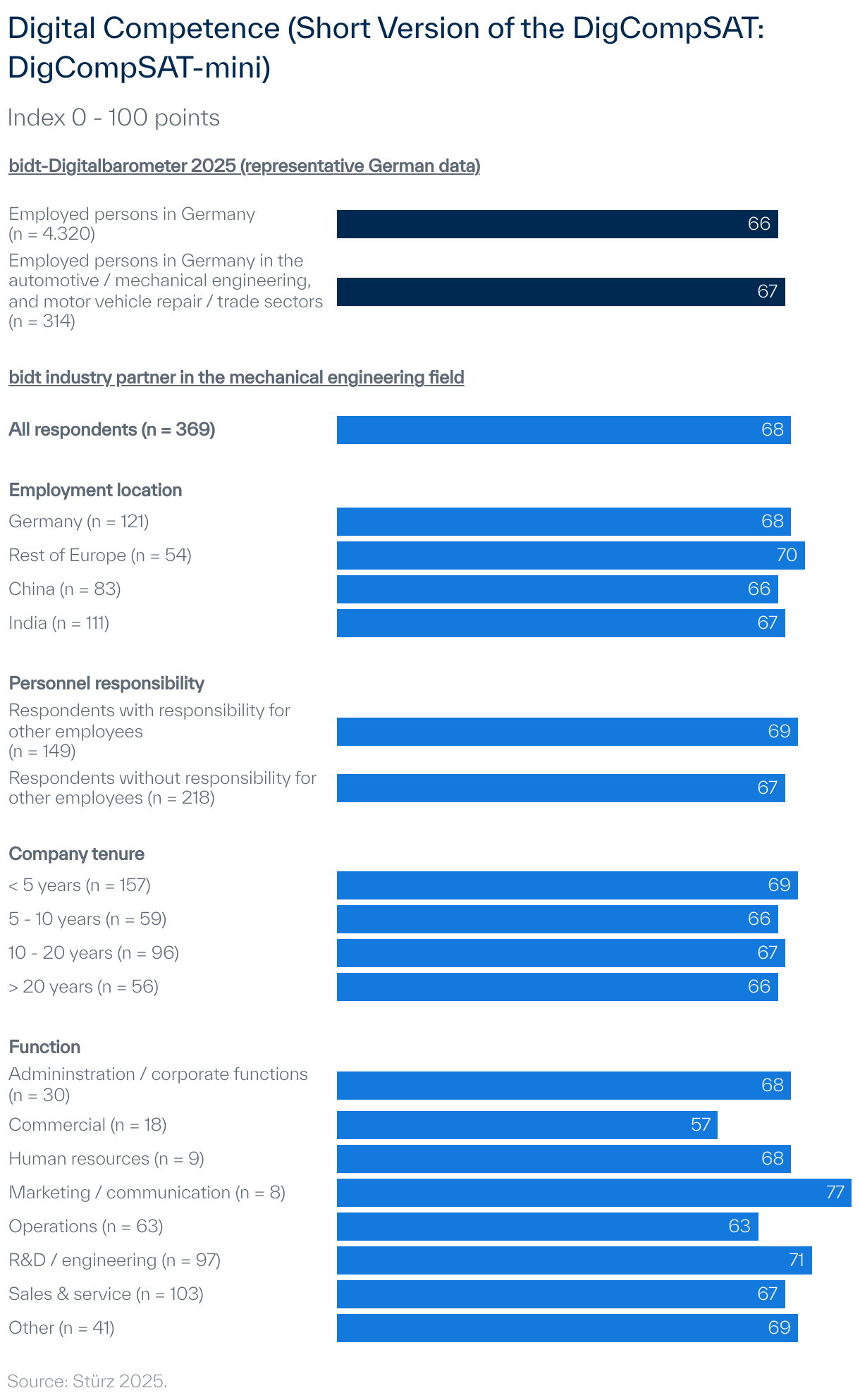
The results show that the surveyed employees of the mechanical engineering company from Germany, with an average of 68 points, have similar digital skills to employees in the vehicle and mechanical engineering sector and vehicle repair and trade in Germany in general (67 points). Employees at the company in other European countries scored slightly higher at 70 points. The average values for employees surveyed in China (66 points) and India (67 points) are slightly lower than the value determined for Germany. Employees with personnel responsibility have slightly higher digital skills (69 points) than employees without personnel responsibility (67 points). In terms of length of service, it can be seen that new employees have slightly higher digital skills than employees who have been with the company for longer. There are greater differences in digital skills by functional area. For example, employees in Marketing/Communications achieve the highest competence score, while employees in Commercial achieve the lowest (Stürz 2025).
Klicken Sie auf den unteren Button, um den Inhalt von Datawrapper zu laden.
Conclusion
The pilot project on the use of the DigCompSAT in companies shows how the DigCompSAT-mini short version of the self-assessment test can lead to an initial assessment of the distribution of general digital skills among employees in companies. This provides an important overview of the general digital fitness of employees for the digital transformation. Advantages arise from the simple, efficient and short-term application option without the need for adaptation to specific roles or functions of employees, as well as from the direct external connectivity due to the foundation on the European DigComp reference framework. Limitations exist due to the relatively abstract, global results without concrete reference to the individual requirements of the company for specific roles or functions. Therefore, the test should only serve as a starting point for all employees in order to build on this to carry out more detailed and needs-orientated assessments of employees’ digital skills in individual functional areas. For example, a combination with specific in-depth qualitative interviews, as carried out by the practice partner, can contribute to a holistic assessment of the status quo of digital transformation in the company.
To the Digitalbarometer
To the Findings Report
About the research project
Literature
Clifford, I. et al. (2020). DigCompSAT. Luxembourg. https://publications.jrc.ec.europa.eu/repository/handle/JRC123226 [29.11.2021].
Europäische Kommission (2021). Digital Economy and Society Index (DESI) 2021, Country Report: United Kingdom. Brüssel.
https://digital-strategy.ec.europa.eu/en/policies/desi [30.11.2021].
European Commission (2025). Current developments on DigComp (2024-2025).
https://joint-research-centre.ec.europa.eu/projects-and-activities/education-and-training/digital-transformation-education/digital-competence-framework-citizens-digcomp/current-developments-digcomp-2024-2025_en [03/09/2025].
European Parliament (2017). Digital skills in the EU labour market. Bruxelles, Belgium.European Parliament (2017).
Ferrari, A. (2012). Digital Competence in Practice: An Analysis of Frameworks. Sevilla.
https://op.europa.eu/de/publication-detail/-/publication/2547ebf4-bd21-46e8-88e9-f53c1b3b927f/language-en [29.11.2021].
JISC (2014). Developing Digital Literacies. Bristol.
https://www.jisc.ac.uk/full-guide/developing-digital-literacies [29.11.2021].
Schleiter, A./Da Silva Zech, G. (2020). Digital skills – increasingly important for employers. Gütersloh.
https://www.bertelsmann-stiftung.de/de/publikationen/publikation/did/policy-brief-202004-digitale-kompetenzen-fuer-arbeitgeber-immer-wichtiger-all.
Schlude, A. et al. (2025). Results report on the bidt Digital Barometer 2025. Munich.
https://www.bidt.digital/publikation/ergebnisbericht-zum-bidt-digitalbarometer-2025/ [16 OCTOBER 2025].
Stürz, R. et al. (2022). The bidt-SZ digital barometer. Munich.
https://www.bidt.digital/publikation/bidt-sz-digitalbarometer/ [26/09/2025].
Stürz, R. et al. (2023). bidt-Digitalbarometer.international. Munich.
https://www.bidt.digital/publikation/bidt-digitalbarometer-international/ [01/02/2024].
Stürz, R. et al. (2025). The bidt Digital Barometer 2025. Munich.
https://www.bidt.digital/publikation/das-bidt-digitalbarometer-2025/ [16 OCTOBER 2025].
Stürz, R. (2025). General Digital Fitness of Employees: Applying the DigCompSAT in Companies. In: López-Baldominos, I., Pospelova, V. (Hg.). ICODSIP 2025, Proceedings of the 2nd International Conference on Digital Skills and IT Professionalism. p. 102-104.
Vuorikari, R. et al. (2016). DigComp 2.0: The Digital Competence Framework for Citizens.
Luxembourg. https://publications.jrc.ec.europa.eu/repository/handle/JRC101254 [29.11.2021].
Vuorikari, R./Kluzer, S./Punie, Y. (2022). DigComp 2.2: The Digital Competence Framework for Citizens. Luxembourg.
https://op.europa.eu/de/publication-detail/-/publication/50c53c01-abeb-11ec-83e1-01aa75ed71a1/language-en [07.06.2023].
Vuorikari, R./Pokropek, A./Muñoz, J. (2025). Enhancing digital skills assessment: introducing compact tools for measuring digital competence. In: Technology, Knowledge and Learning.
The blog posts published by the bidt reflect the views of the authors; they do not reflect the position of the institute as a whole.


