

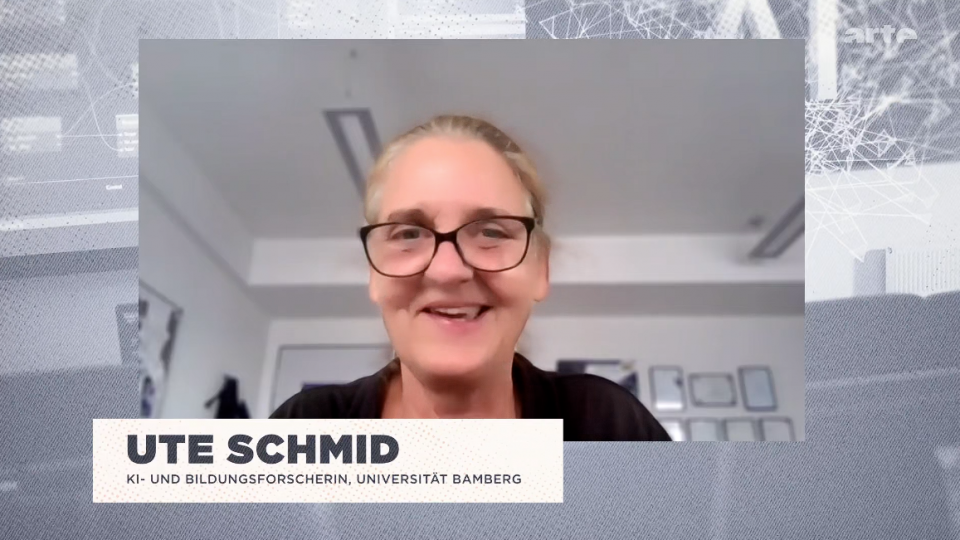
Whether it’s homework, presentations or essays: generative AI provides pupils and students with results in a matter of seconds. In a report on ZDF’s ‘heute’ programme and in an ARTE documentary, Professor Ute Schmid, a member of the bidt Board of Directors, explains what this means for schools and universities. She also assesses the opportunities and risks of AI in two further reports.
AI at university?
AI can be used in a variety of ways in everyday student life – from research and summarising content to drafting one’s own texts. But what does this mean for academic life? The report ‘AI at university?’ on the ZDF ‘heute’ programme on 25 October 2026 explores this question.
How AI is handled, particularly in relation to examination, often varies from course to course and requires a shift in mindset. Whilst around half of students use artificial intelligence on a daily basis, the picture among lecturers is more nuanced: some reject its use, whilst others are increasingly integrating AI into their teaching. Speaking about the expectations placed on her students, Ute Schmid says:
Our students are allowed to take all their notes into the exam. However, during the written exam, access to the internet – and therefore to chatbots – is not permitted.
 Prof. Dr. Ute Schmid To the profile
For her, it is crucial that examinations are taken on the basis of students’ own performance, but AI can certainly serve as a support in the learning process.
AI in the classroom: a learning booster or a mental brake?
Similar questions are being asked not only at universities but also in schools. The ARTE documentary ‘The Future of Learning: Does AI Make Pupils Stupid?’ shows that young people across Europe are using AI applications such as ChatGPT – whilst teachers and education systems are still in the process of redefining their role in the AI age. Ute Schmid is featured as one of the German experts and calls, amongst other things, for the abolition of homework.
In Estonia, the use of chatbots is not only encouraged but also actively promoted: thanks to a partnership with OpenAI and a version of ChatGPT optimised for use in schools. Pupils can thus work with their own digital teacher, who does not just provide quick answers but more so encourages them to think for themselves. Schmid also advocates personalised learning with AI for Germany – starting, for example, from Year 5.
However, artificial intelligence is already having a very real impact on teaching, as the professor also confirms. Not only are there, for example, incorrectly generated worksheets in circulation, but Schmid also warns that AI could even make pupils ‘dumber’:
Given how uncontrolled and unregulated the current applications are, I also see a major risk here.
Prof. Dr. Ute Schmid To the profile
To counter negative developments or prevent them from the outset, schools must be made ‘AI-ready’. For Schmid, this means a fundamental change to the structure of the education system. This should include the abolition of homework, as well as all-day schools with personalised learning and, in particular, streamlined curricula. This is because, up to now, these have neglected the understanding of correlations, the transfer of problem-solving skills and, moreover, reflection.
Whether AI promotes learning does not depend solely on the technology. It also depends on the skills that teachers impart and the framework conditions that schools create for a reflective approach to artificial intelligence.
Understanding AI, not banning it
Schmid also expressed this view at the Kortizes Symposium in early October at the Germanisches Nationalmuseum in Nuremberg, as reported by the Humanist Press Service (hpd).
Instead of banning AI from schools or even fearing it, she argued, a basic understanding of the concepts and methods must be taught. However, she noted that the education system is not yet up to speed with technological developments in this regard. Her conclusion is:
It is important to realise that self-directed learning is a good thing.
Prof. Dr. Ute Schmid To the profile
The computer scientist also put the debate on supposed threats posed by artificial intelligence into perspective. It is not the AI models themselves that are dangerous, but the business models and practices behind them. Yet she sees this as an opportunity for Europe and its humanistic view of humanity.
A call for greater transparency
The risks posed by AI are also the subject of an interview with Alexander Jungkunz in the ‘Nürnberger Nachrichten’. In it, Schmid comments on the call to pause AI development in order to contain the risks. Rather than fuelling fear, she advocates for greater transparency.
AI has long since found its way into schools and universities – be it for homework, presentations or essays. The question remains as to how to deal with it properly.
In all her articles, Ute Schmid makes it clear: anyone who understands how artificial intelligence works can use it purposefully as a tool and critically evaluate its results. This requires AI literacy among both learners and teachers. In this way, artificial intelligence can foster independent thinking rather than replacing it.
To the articles
ZDF heute (in german)
Arte Documentary (in german)
Humanist Press Service (in german)
Nürnberger Nachrichten (paid content, in german)


