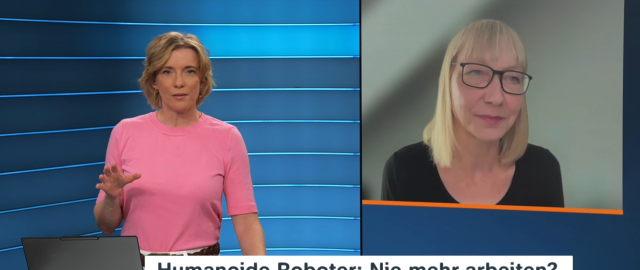


As part of the SZ series “The World 2035 – How will we live in ten years?”, Professor Sabine Pfeiffer answers pressing questions about the development of our working world in the course of the digital transformation in an interview in the Süddeutsche Zeitung on 31 August 2025. Pfeiffer holds the Chair of Sociology at Friedrich-Alexander-Universität Erlangen-Nürnberg, specialising in technology, work and society. The bidt director has long been interested in how the digital transformation is changing the way we work. In an interview with SZ political editor Benedikt Peters, Pfeiffer firmly rejects sweeping negative predictions from Silicon Valley: she does not see mass unemployment or the eradication of entire industries on the horizon.
The hype surrounding AI apps is currently overshadowing their inherent limitations. Pfeiffer warns that faulty AI-generated content could soon dominate online content and that trust in AI apps will diminish. In the long term, algorithms tend to standardise content and wording, which reduces the quality of AI output in the long term. These are outgrowths of structural deficits and systemic limitations of AI models. We will therefore continue to need people who think innovatively, check facts and research topics. Pfeiffer is convinced:
"Humans will still be ahead of AI in 2035."
 Prof. Dr. Sabine Pfeiffer To the profile
This does not mean that there will be no change and no transformation. Artificial intelligence will take over some activities in 2035 that were previously reserved for humans. However, Pfeiffer sees AI less as a threat and more as a potential. For example, a doctor’s surgery could certainly simplify appointment booking through the use of AI, but not replace the medical assistants who measure patients’ blood pressure or provide medication. These specialist skills will remain important on the labour market. AI could also make a contribution in other sectors by helping to reduce bureaucracy and making it easier for staff to focus on the essentials.
To the Article (in German)