


Using the generative AI tool OneTutor as an example, the study examines the use of generative AI in university teaching and analyses the experiences of lecturers and students. For instance, it assesses the subjectively perceived learning success of students and their experiences with the tool for various purposes. The study is based on survey and usage data from OneTutor collected from students and lecturers during the 2025 summer semester at ten universities and colleges in Bavaria participating in a pilot project to roll out OneTutor. Students were surveyed both within the OneTutor tool and in the relevant courses outside the tool. The latter survey, referred to as the classroom survey, collected data from both users and non-users of the tool. In addition, lecturers were asked about their experiences with using OneTutor in teaching.
Overview
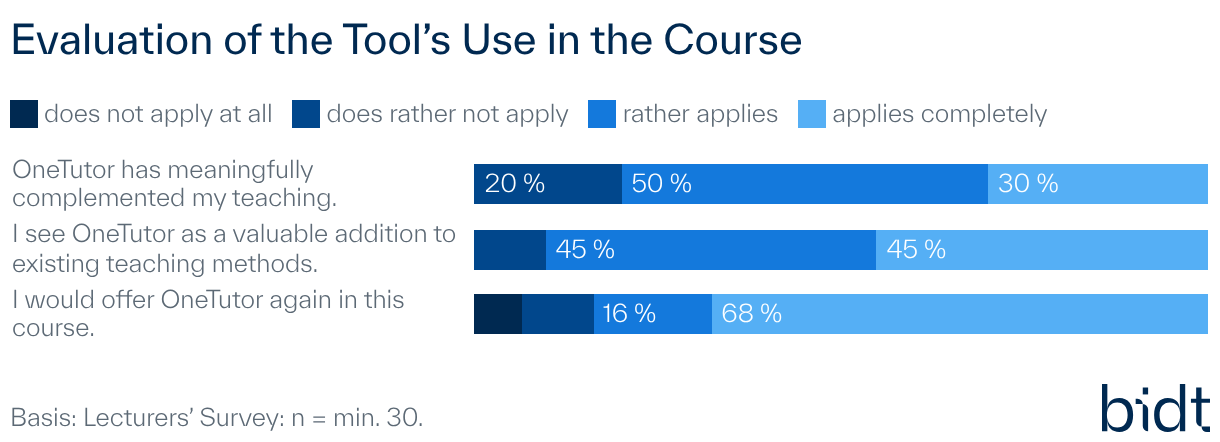
The results show that OneTutor is perceived positively by the majority of lecturers. The use of the AI tool in teaching is often seen as a useful addition to existing teaching methods. This is despite the perception that, at least currently, its use involves a certain amount of additional effort when used for the first time in a course.
Klicken Sie auf den unteren Button, um den Inhalt von Datawrapper zu laden.
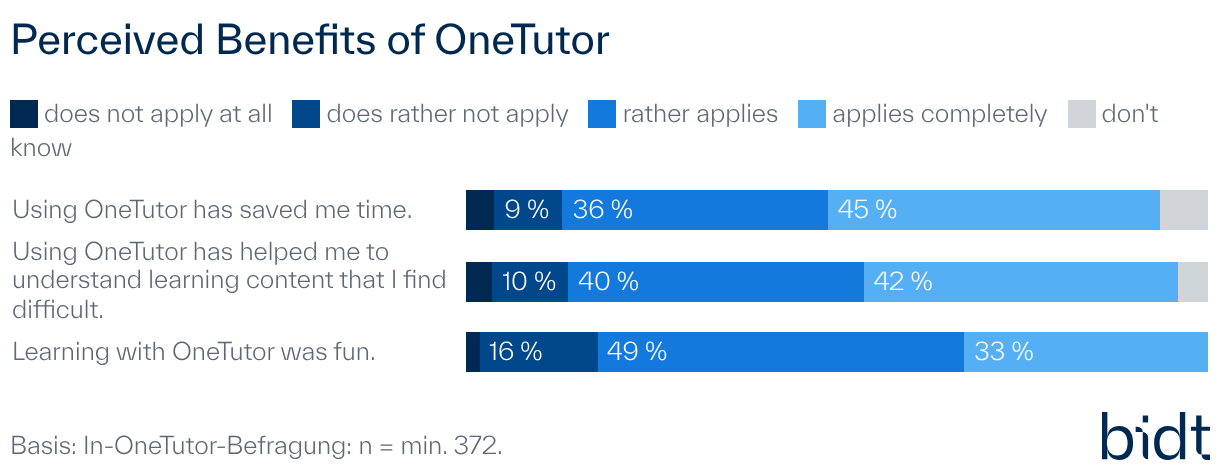
Among students, a large majority of OneTutor users see the tool as a helpful learning opportunity for exam preparation. In addition, various aspects of learning with OneTutor are predominantly rated as positive.
Klicken Sie auf den unteren Button, um den Inhalt von Datawrapper zu laden.
The quiz and chat functions of the AI tool are used in different ways; the quiz function in particular seems to be used by students primarily for exam preparation.
Non-users of OneTutor primarily attribute their non-use to personal learning preferences for other learning methods, but are generally not averse to generative AI.
According to the students’ own decision to use or not use OneTutor in the courses, in line with the non-experimental research design, the available data do not reveal any differences in subjectively perceived learning success between frequent users, infrequent users and non-users of OneTutor. Together with the positive effects on learning success through OneTutor for students who use it, the results thus far point in the following direction: students who use OneTutor achieve positive learning effects through the tool, but students who have other preferences and do not use OneTutor can achieve similar learning success with other learning methods. In addition, OneTutor seems to be generally perceived and used as a supplementary rather than a new central learning resource. For example, many students report that they use other generative AI systems for learning in addition to OneTutor for the course.
The research design, which is not experimental in nature but leaves the self-selection of OneTutor use to students and lecturers, has a limiting effect on the results and their interpretation. In addition, for data protection reasons, no objective learning success data could be obtained. Another limiting factor is that, due to the number of cases achieved, the concentration of survey data on a few courses and further self-selection in the surveys, it is not possible to generalise the results or make a comprehensive comparison between subject groups, for example.


