



Project description
Digital transformation has the potential to fundamentally change individual companies and entire industries. New digital technologies not only offer opportunities to optimize existing processes but also enable new products, services, and business models. This is particularly relevant for the traditional engineering sector. Established engineering companies, such as those in the automotive or process engineering industries, generally have a strong technology focus. However, their expertise to date has not primarily been in digital solutions. Rather, software and digital technologies have played a supportive role in established processes. New digital technology developments offer them a wide range of avenues for innovation, such as novel digital product features, services, processes, or entirely new business models. Meeting this potential means challenging the established setting and embracing transformation.
While digital innovations offer new possibilities, the digital transformation of traditional engineering companies can bring about far-reaching changes across organizational levels. Digital transformation goes beyond simply implementing new digital technologies – it affects the entire organization.
Against this backdrop, our interdisciplinary research project combined sociological and management perspectives to investigate the organizational challenges and implications associated with these changes. We focused on how established engineering companies deal with internal tensions arising during digital transformation – for instance, between tradition and renewal, between engineering culture and software-oriented thinking, or between established and emerging forms of expertise.
Based on several qualitative case studies, we examined digital transformation not only as a technological or strategic change process but also as a social negotiation process. Three subprojects explored key aspects of digital transformation in engineering companies.
Subproject 1 „Digital Transformation as a Question of Identity”, investigated the role of organizational identity in digital transformation.
Subproject 2 „Engineers in Digital Transformation – A Crisis of Professional Identity”, examined the implications of digital transformation for professional self-understandings, professional boundaries, and group dynamics among technical professions.
Subproject 3 „Digital Transformation as a Balancing Act Between Participation and Leadership”, focused on the conditions for effective employee participation. This research question is being continued and further developed in the project „Participation and Co-determination in Digital Transformation“. Building on our research findings, we also developed a meta-concept of companies’ digital change.
Overall, our findings show that digital transformation is not simply a matter of implementing and using new technologies. It also affects organizational self-understandings, professional identities and status relations, as well as questions of leadership and participation. Successfully managing digital transformation therefore requires considering the technological, strategic, and social dimensions of change together and deliberately aligning them.
Key Findings at a Glance
Digital transformation is a phase of fundamental reorientation within a continuous process of digital change
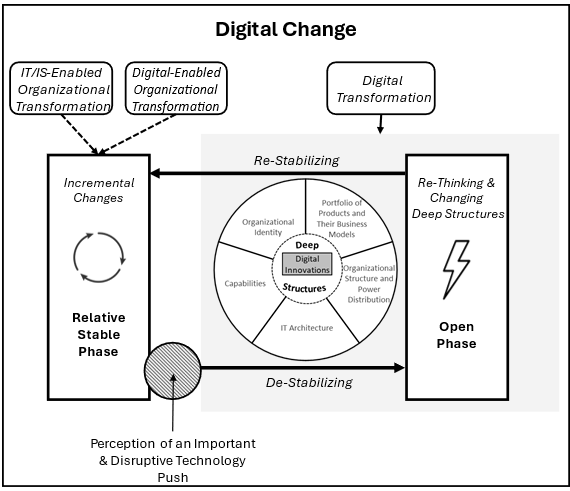
Companies are not permanently in a process of transformation. Rather, relatively stable phases of incremental change alternate with open phases of digital transformation, in which fundamental organizational decisions are revisited.
Digital transformation is a social and organizational process of negotiation
Digital transformation changes not only technologies, processes, and business models but also affects the organizational identity, professional identities, and the distribution of expertise, responsibility, power, and appreciation. At the same time, it creates new challenges for the relationship between leadership and employee participation.
The course of digital transformation is shaped by the established organizational setting and how it is configured
The arrangement of historically developed organizational identity, professional self-understandings, and status hierarchies can constrain change, but it can also serve as a resource for shaping it. A key factor is how new digital activities and forms of expertise are organizationally embedded and connected to established structures and practices.
Practical Implications and Recommendations
Consciously clarify the scope and direction of change
Companies should assess at an early stage whether new digital technologies can be implemented within established organizational structures or whether more fundamental transformation is required. This involves jointly considering the potential implications for business models, organizational structures, capabilities, power distribution, and organizational identity. In the case of profound digital transformation, companies should also clarify the organizational configuration they aim to achieve and the criteria for reaching a new state of organizational stability.
Actively shape the organization’s future identity
Companies should deliberately consider which aspects of their organizational identity to preserve, further develop, or abandon during digital transformation. Different visions of the company’s future should be made internally visible at an early stage and related to the strategic objectives of the transformation. Developing a collectively shared sense of direction plays a crucial role for a successful digital transformation.
Translate tradition into a digital future
Historically emerged values and capabilities should neither be preserved uncritically nor discarded too quickly. Instead, companies should examine which established strengths remain valuable in light of new technologies, products, and business models, and how they can be transferred to new contextual conditions. At the same time, companies should identify which traditional assumptions and understandings may constrain necessary changes.
Manage roles, responsibilities, and collaboration between expert groups carefully
When developing and introducing digital innovations, responsibilities, decision-making authority, and intersections with established expert groups should be clarified at an early stage. Companies should therefore consider potential status dynamics associated with the organizational positioning and resource allocation for new digital units. Shared objectives, joint project responsibilities, and defined forms of knowledge exchange can help prevent boundary drawing, status conflicts, functional silos, and the diffusion of responsibility.
Enable employee participation while providing clear strategic direction
General calls for participation are not sufficient. Managers should clearly communicate the strategic direction of digital transformation while creating concrete opportunities for employees to contribute to the design and implementation of change. Responsibilities, time resources, and procedures for handling the ideas that employees bring in should be clearly defined. Equally important is transparent feedback on which ideas are taken up and why.
Findings in Detail
Digital change as an alternation between open and relatively stable phases
Digital change is not a one-time event. However, it is neither a permanent state of fundamental transformation. Instead, in the meta-concept of digital change we developed throughout the project, we distinguish between relatively stable phases of incremental change and open phases of fundamental reorientation.
During relatively stable phases, companies operate within their established organizational setting, while their organizational deep structures remain largely unchanged. Digital technologies are used to make processes more efficient, further develop existing products and services, or gradually integrate new digital features. Although change is continuous during these phases, it does not involve fundamental directional decisions that affect the company’s organizational scaffold. In contrast, companies enter an open phase when the potential of a new digital technology is perceived as fundamentally ‘game-changing’ and adjustments within established structures are no longer sufficient. During this phase, one or more dimensions of the organization’s deep structures are questioned and reconfigured. The challenge is no longer simply to integrate digital technologies into the existing organizational setting. Instead, fundamental fork-in-the-road decisions become necessary regarding the product portfolio and business models, organizational structure and power distribution, IT architecture, capabilities, and organizational identity. In this vein, digital transformation represents an open phase of fundamental organizational reorientation. It is therefore not a permanent state. It is a temporary phase that comes to a close once major directional decisions have been made, translated into organizational structures and practices, and re-stabilized. The company then re-enters a relatively stable phase in which digital innovations can be continuously developed based on the reconfigured organizational setting. At a later point, emerging digital technologies may again trigger another open phase and thus further digital transformation processes. Digital change is therefore a permanent ongoing process, while digital transformation represents a temporally bounded phase of fundamental alteration affecting the organization as a whole.
Further reads
The mutual interplay between digital transformation and organizational identity
Digital transformation of traditional engineering companies affects more than technology – it concerns the organization as a whole and raises a fundamental question: “Who are we – and who do we want to be in the future?”. The answers to these questions have far-reaching implications, as they shape not only the company’s external image but also how organizational members make sense of their organization. Organizational identity provides a frame of reference and orientation, defines which courses of action appear plausible and legitimate, and provides an important basis for a sense of belonging and collective action. Digital transformation thus literally becomes a question of identity. Against this backdrop, we investigated the role of organizational identity in digital transformation and how companies negotiate the relationship between their established identity and their future vision.
Our studies show that digital transformation and organizational identity are closely intertwined and mutually affect each other. On the one hand, organizational identity serves as a point of departure for digital transformation. It provides the frame of reference against which the potential of digital technologies is perceived and evaluated. In this way, organizational identity shapes digital transformation. It can enable or constrain change and influences how and to what extent digital transformation is realized. On the other hand, digital transformation triggers an identity quest and initiates a collective process of sensemaking and renegotiation concerning its (future) identity.
Key Findings
How digital transformation is organized shapes its impact on organizational identity
Different modes of strategically and structurally implementing digital transformation have different implications for organizational identity. Important factors include whether digital initiatives are integrated into existing structures or organized in separate units, and whether they aim to further develop established forms of value creation or introduce fundamentally new offerings. An archetype framework developed in the project identifies four ideal-typical pathways of organizational identity change: expanding identity, fragmenting identity, revising identity, and reinventing identity. In particular, organizing digital initiatives in separate units while simultaneously pursuing far-reaching changes in value creation can lead to an identity crisis or identity fragmentation. By contrast, integrated approaches that build on established forms of value creation are more likely to enable a gradual development of organizational identity.
Visions of the future emerge against the background of the organizational identity
Organizational identity provides members with a frame of reference for interpreting digital transformation and developing ideas about the company’s future. It offers orientation while also defining which developments appear imaginable, plausible, and legitimate. Which aspects of a collective identity are emphasized and how they are interpreted also depend on the respective positions of organizational members. Accordingly, different groups and actors develop different understandings of digital transformation and where it should lead. These visions of the future are related to one another through collective processes of negotiation.
A company’s past can serve both as a constraint and as a resource for change
Historically developed values, routines, and understandings of success do not inherently prevent or promote change. What matters is how they are mobilized and interpreted in the course of digital transformation. When the past is used to draw boundaries around digital developments and treated as fixed, unquestionable standards, it can narrow the scope of legitimate change. In contrast, when the company’s legacy is collectively reflected, reinterpreted, and connected to visions of a digital future, it can legitimize change while also providing continuity. Organizational legacy is thus activated through negotiation processes and can become a resource for reconciling continuity and change.
Further reads
(IN GERMAN)
In engineering companies, engineers are traditionally the central group of technical experts. Engineering expertise has long been the hallmark of successful engineering companies. Engineers stand for stability, technical precision, and innovation. However, with the growing importance of digital technologies and software, data, and analytics capabilities, the requirements for technical expertise are changing. New expert groups are gaining importance, challenging established professional identities, responsibilities, and status positions. Against this backdrop, we investigated how relationships between “classical” engineers and software experts develop, what tensions, adjustments, and shifts in power emerge, and how these dynamics affect the company’s digital transformation.
Our studies show that digital transformation challenges both the established position of traditional technical professions within the company and their professional self-understanding. Consequently, previously taken-for-granted assumptions about what constitutes engineering expertise are increasingly consciously reflected upon. Responses range from reinforcing boundary work vis-à-vis software expertise to broadening professional self-understandings in ways that recognize different technical capabilities as equally valuable and complementary. At the same time, professional boundaries, responsibilities, authority, and power and status positions are renegotiated. The extent to which these dynamics become conflictual also depends on how new digital expertise is organizationally embedded and positioned in relation to established expert groups. Poorly managed group dynamics can hamper collaboration and jeopardize the overall transformation process.
Key Findings
Digital transformation triggers the renegotiation of professional identities and boundaries
The growing importance of software and digital capabilities prompts engineers to increasingly reflect upon their previously taken-for-granted professional self-understanding. Engineers may respond to the increasing revalorization of software expertise by reinforcing professional boundaries and emphasizing differences. But they may also broaden their professional identity, recognize software experts as equally legitimate technical professionals, and view different competencies as complementary. Digital transformation can therefore lead either to stronger professional boundaries or to the emergence of a broader, shared understanding of technical expertise.
Digital transformation sparks shifts in power and status relations between expert groups
Changing expertise requirements also challenge established assumptions about which groups possess legitimate expertise within the company, who takes responsibility, and which activities receive particular recognition. In consequence, power and status relations are called into question. Established groups may respond by defending their positions, while new digital expert groups struggle for legitimacy and recognition. How these dynamics unfold also depends on the organizational configuration of digital transformation. For example, A separate digital unit that receives particular attention and support from management may be perceived by established employee groups as a threat to their status, thereby reinforcing professional boundaries. Even in interdisciplinary and cross-functional projects, collaboration is shaped by different power positions and professional orientations, which may manifest as mutual stereotyping, functional silos, knowledge withholding, or shifting responsibility between groups. Such power and status dynamics not only hamper collaboration but can also jeopardize the success of digital transformation and innovation projects as a whole.
Further reads
The far-reaching changes associated with digital transformation often generate uncertainty, resistance, and conflicts within companies, potentially jeopardizing the success of the transformation process. It is therefore essential to actively involve employees in the transformation – not merely to increase acceptance but also to enable genuine identification with the change process and thereby contribute to its success. Against this backdrop, we investigated how managers and employees understand participation in digital transformation, what they expect from each other, and how employee involvement can be aligned with managerial direction. This research is being continued and further investigated in the research project „Participation and Co-determination in Digital Transformation”. The focus is on the concrete forms and organizational conditions under which participation and co-determination can become effective in digital transformation processes.
Preliminary Findings
Participation is generally supported but understood differently
Managers and employees agree that participation is an important factor for successful digital transformation. However, they differ in their understanding of what participation actually means and who is responsible for enabling it. While some managers expect employees to proactively seek information, contribute ideas, and actively support change, employees expect management to provide concrete opportunities for participation. If these different expectations remain unaddressed, it leads to a deadlock in which both sides wait for the other to take the initiative.
Effective participation combines clear leadership with meaningful employee involvement in shaping work processes
Employees do not expect strategic decision-making to be transferred entirely to the workforce. Rather, they want management to provide a clear strategic direction and make binding decisions, while involving them at an early stage, particularly when changes affect their own work processes. Providing information alone is not sufficient. Meaningful participation requires dialogue, concrete opportunities for employees to contribute their know-how, and transparency about how their suggestions are assessed and taken forward. Leadership and participation are therefore not opposites but need to be deliberately combined throughout the transformation process.
Further reads
Project team

Prof. Dr. Thomas Hess
Member of bidt's Board of Directors and the Executive Commitee | Director of the Institute for Digital Management and New Media, Ludwig-Maximilians-Universität

PD Dr. Angela Graf
Research Staff Unit, Research Coordinator “Economy and Labour” and Research Project Leader, bidt

Alumni

Publications

From Insight to Action:
Practical Implications from Interdisciplinary bidt Research Projects for Navigating Digital Change in Organisations
This publication brings together practice-oriented insights into digital change in organisations from four interdisciplinary research projects conducted at the Bavarian Research Institute for Digital Transformation (bidt). The contributions address different key challenges of digital transformation and deepen the understanding of the organisational dynamics and complex interdependencies that shape digital change. The publication is explicitly aimed at practitioners and provides concrete, practice-oriented guidance for the evidence-based and responsible shaping of digital transformation processes in organisations.
Articles
Articles (IN GERMAN)
Articles
Articles (IN GERMAN)
ARTICLES