
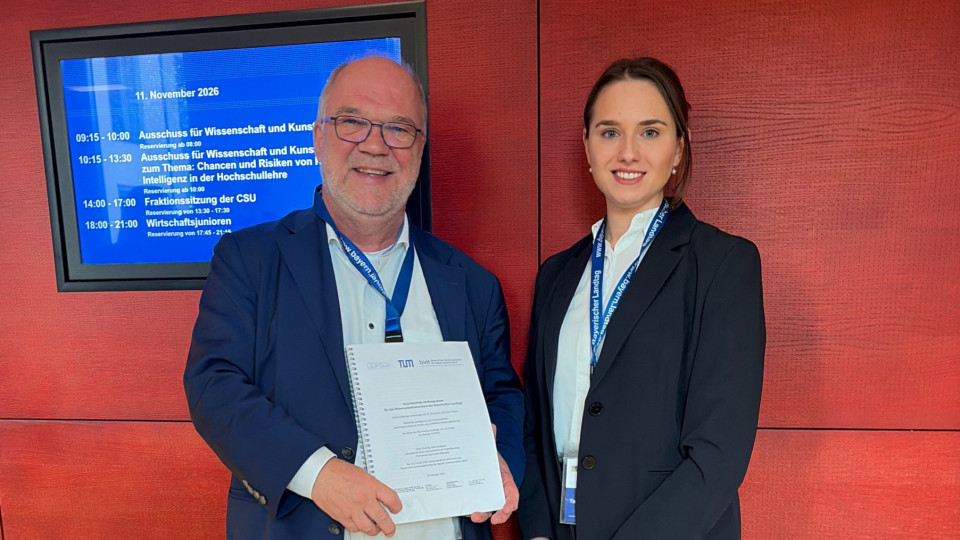
On 11 November, the Bavarian State Parliament’s Committee on Science and the Arts discussed the opportunities and risks of artificial intelligence (AI) in higher education. Among the invited experts was Professor Dirk Heckmann from the Technical University of Munich, who is also a member of the bidt Board of Directors. Together with Carolin Fuß, a researcher at the Bavarian Research Institute for Digital Transformation (bidt), he had previously drafted a written expert opinion for the committee.
to the expert opinion (in german)
The ‘ban on banning AI’
The hearing was prompted by the amendment to the Bavarian Higher Education Innovation Act currently under discussion in the Bavarian State Parliament. It provides for the use of AI in unsupervised written examinations to be permitted in principle, whilst at the same time setting out requirements for documenting the use of AI – the so-called ‘AI ban ban’.
In their statement, Heckmann and Fuß welcome these changes in principle, but emphasise the need for a clear legal framework. Particular focus is placed on the question of how individual examination performance and competencies can continue to be recognised, the formulation of labelling requirements, and the possible supplementation of written examinations with oral components. Data protection requirements, for example in the case of remote examinations, are also addressed. The specific implementation lies with the universities and their examination regulations.

Research into AI in higher education
The statement builds on the research carried out as part of the bidt’s ‘AFFAIRE’ project led by Professor Dirk Heckmann and Carolin Fuß. It examines the legal framework for the use of generative AI in higher education examinations. The hearing thus also highlights the practical and political relevance of the bidt’s research: academic findings can be directly incorporated into the further development of Bavarian higher education law.
Philipp Csistian, co-founder of OneTutor GmbH, was also invited as an expert witness. The AI learning assistant OneTutor is being scientifically monitored as part of the bidt research project ‘AIffectiveness’. The project investigates how the use of AI learning assistants affects students’ learning behaviour and academic success. During the hearing, Csistian also emphasised the importance of scientific monitoring of such applications in order to ensure their effective use in higher education teaching.
Further links
To the research projects